AI Theatre Session: Interoperability
AI-SC 19 - Update on AI tools for radiology
Lectures
1
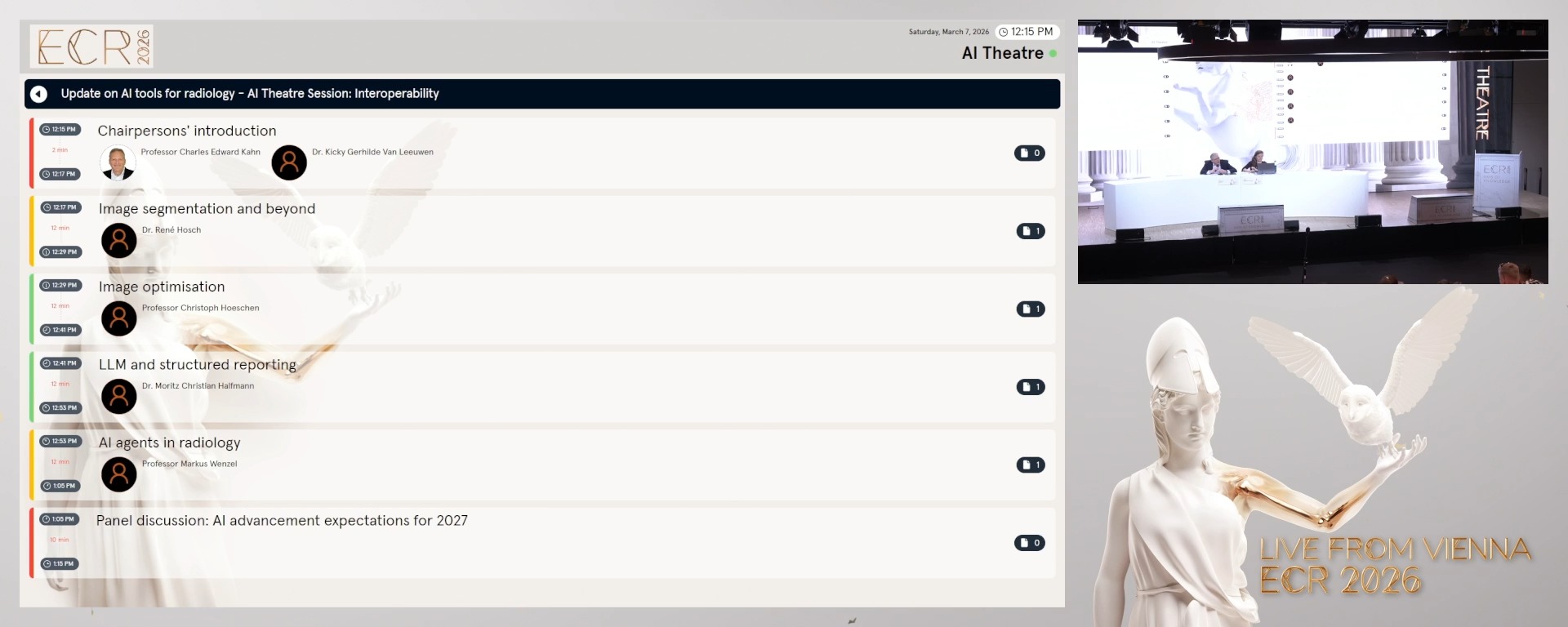
Chairpersons' introduction
02:00Charles Edward Kahn, Philadelphia / US, Kicky Gerhilde Van Leeuwen, De Bilt / NL
2
Image segmentation and beyond
12:00René Hosch, Essen / DE
3
Image optimisation
12:00Christoph Hoeschen, Magdeburg / DE
4
LLM and structured reporting
12:00Moritz Christian Halfmann, Mainz / DE
5
AI agents in radiology
12:00Markus Wenzel, Bremen / DE
2 min
Chairpersons' introduction
Charles Edward Kahn, Philadelphia / United States
Kicky Gerhilde Van Leeuwen, De Bilt / Netherlands
Kicky Gerhilde Van Leeuwen, De Bilt / Netherlands
12 min
Image segmentation and beyond
René Hosch, Essen / Germany
- To learn to frame clinical questions as segmentation tasks and build a lean, generalizable pipeline that turns routine scans into high-value, interoperable outputs.
- To appreciate how masks become an informational gain: extract body-composition metrics, track tumor volume, and generate a clinically relevant information.
- To understand seamless clinical handoff: store segmentations as DICOM-SEG, publish key values as FHIR Observations, and surface them in a linked FHIR dashboard.
12 min
Image optimisation
Christoph Hoeschen, Magdeburg / Germany
- To learn about different options to improve image quality using AI based approaches.
- To appreciate the high potential for reducing e.g. scan time in MR or radiation dose in CT by AI methods.
- To understand critical aspects and pitfalls of the use of AI in image optimisation.
12 min
LLM and structured reporting
Moritz Christian Halfmann, Mainz / Germany
- To learn how large language models (LLMs) can be applied to radiological reporting, including support in draft generation, error reduction, and workflow support.
- To appreciate how LLMs can facilitate structured reporting and standardization, improving clarity, consistency, and data reusability in radiology.
- To understand the current opportunities and future directions for LLM-enhanced radiology reporting, with emphasis on validation, human–AI collaboration, and clinical impact.
12 min
AI agents in radiology
Markus Wenzel, Bremen / Germany
- To understand the distinguishing features of AI Agents and Multi-Agent Systems as opposed to AI Algorithms.
- To appreciate the characteristics of tasks that are amenable to and benefit from AI Agents.
- To learn about barriers and caveats associated with AI Agents and their technology.
10 min
Panel discussion: AI advancement expectations for 2027