Industry Symposium by Canon Medical
IND 34 - The Next Level of Diagnostic Quality in Photon Counting and Area Detector CT: AI, Spectral, and UHR
Lectures
1
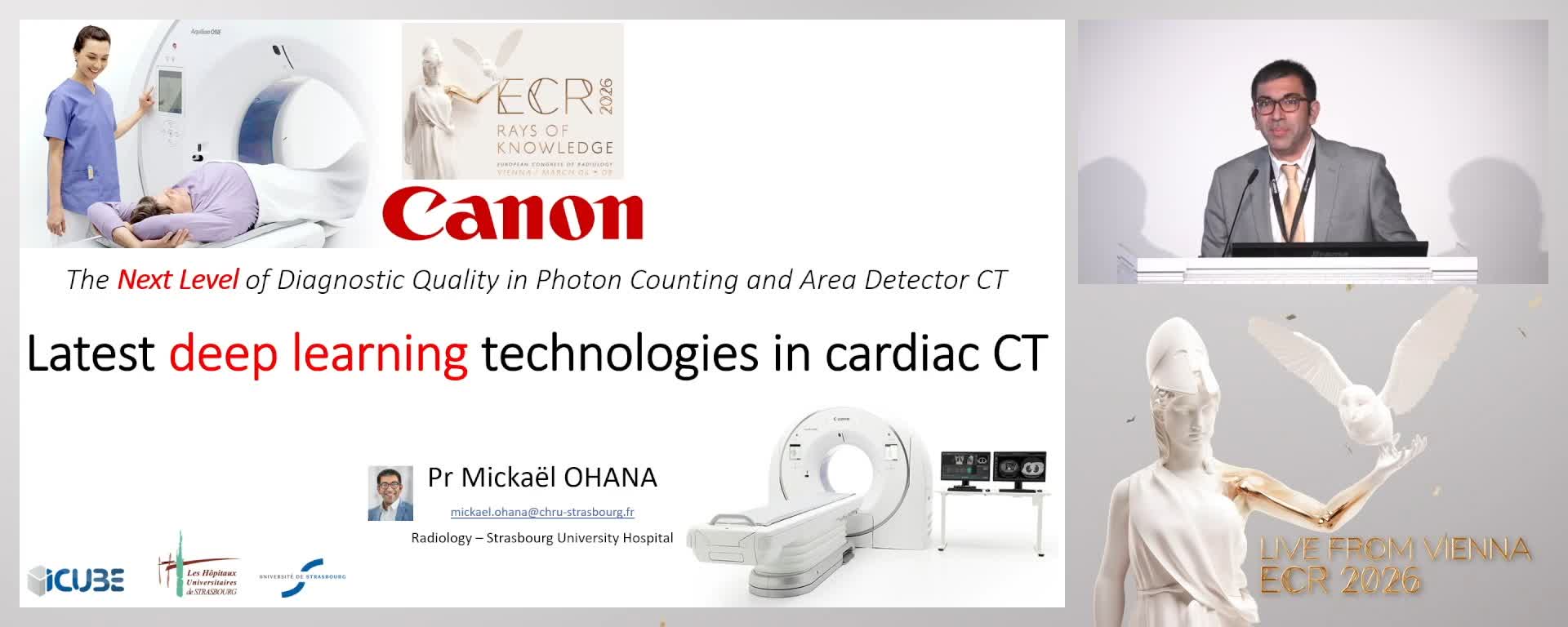
Latest deep learning technologies in cardiac CT: one-beat super-resolution imaging with whole-heart motion correction
15:00Mickaël Ohana, Schiltigheim / FR
2
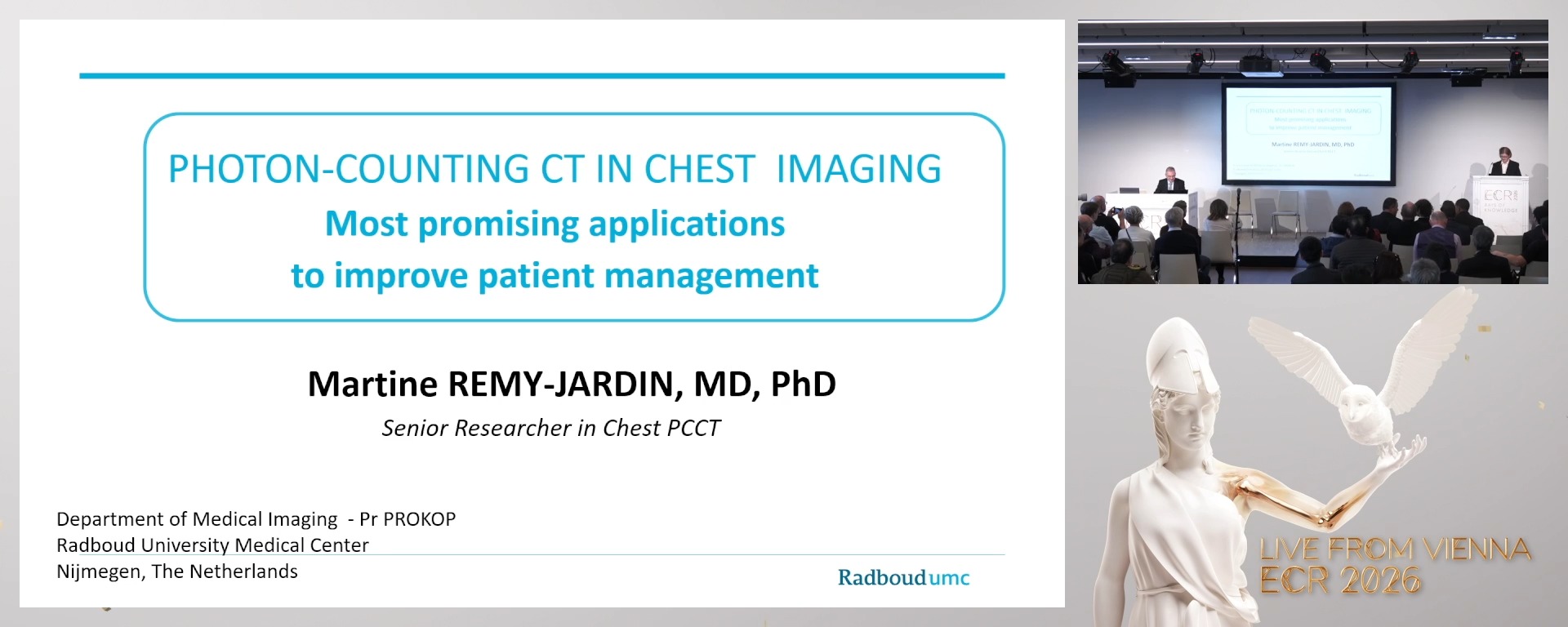
Photon counting CT in chest imaging: most promising applications to improve patient management
15:00Martine Rémy-Jardin, Nijmegen / NL
3
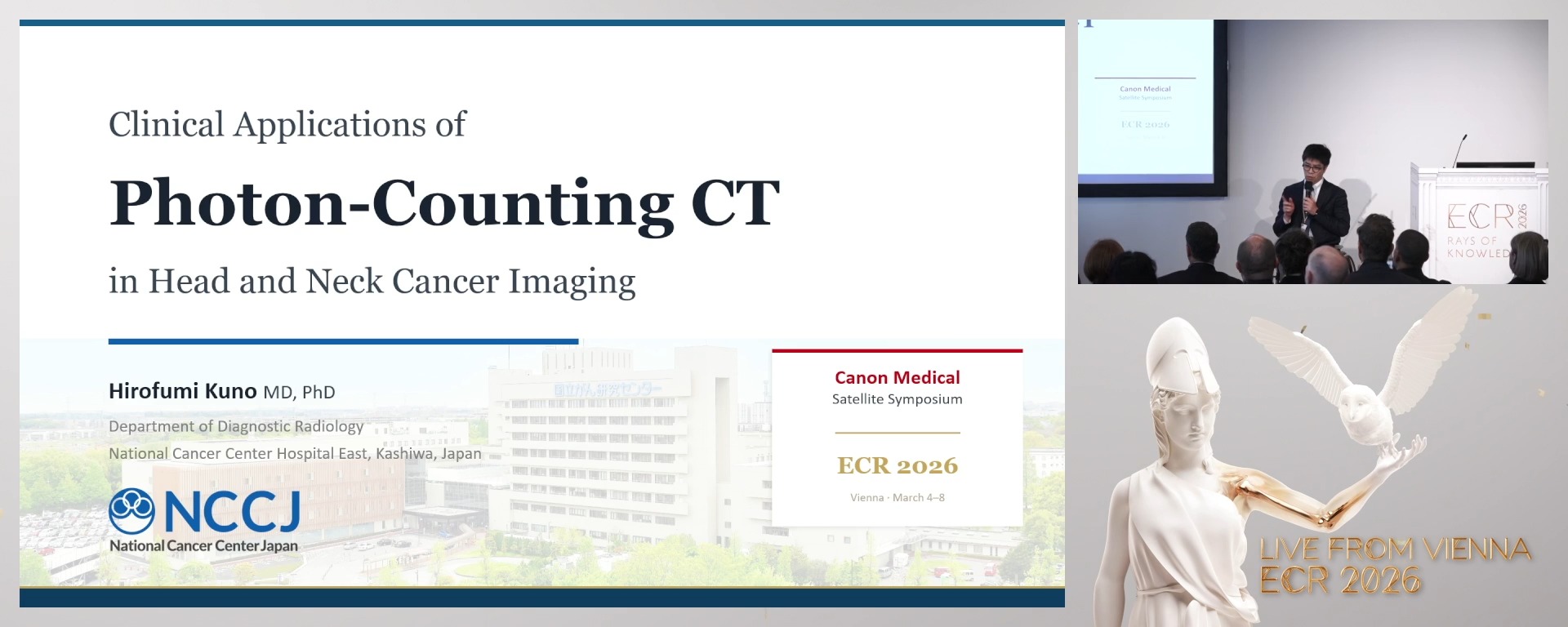
Clinical Applications of Photon-Counting CT in Head and Neck Cancer Imaging
15:00Hirofumi Kuno, Kashiwa / JP
We are entering a new era of CT imaging driven by unprecedented technological innovation. Advances in hardware and deep learning are transforming image quality, enhancing resolution while reducing noise, artifacts, and radiation dose. By combining state-of-the-art detectors with AI-powered reconstruction, CT now achieves super-resolution imaging with less noise, motion artifact correction, and low- and ultra-low-dose performance. These benefits extend beyond conventional to photon counting CT, delivering ultra-high-resolution and spectral images with reduced noise and improved diagnostic value. In this symposium, leading clinical experts will showcase real-world applications of these groundbreaking technologies, and will discuss their impact on diagnostic accuracy and patient care.
15 min
Latest deep learning technologies in cardiac CT: one-beat super-resolution imaging with whole-heart motion correction
Mickaël Ohana, Schiltigheim / France
• Learn how the combination of wide axial coverage and deep learning-based motion correction can improve image quality and diagnostic interpretability in cardiac CT
• Learn the potential of super-resolution deep learning reconstruction to reduce blooming artifacts and increase diagnostic confidence
• Learn the potential of super-resolution deep learning reconstruction to reduce blooming artifacts and increase diagnostic confidence
15 min
Photon counting CT in chest imaging: most promising applications to improve patient management
Martine Rémy-Jardin, Nijmegen / Netherlands
• Summarize the most recent results with photon counting in chest imaging
• Explain the importance of state-of-the-art deep learning reconstruction for image quality improvement and radiation dose reduction.
• Explain the potential impact of photon counting CT in clinical patient management.
• Explain the importance of state-of-the-art deep learning reconstruction for image quality improvement and radiation dose reduction.
• Explain the potential impact of photon counting CT in clinical patient management.
15 min
Clinical Applications of Photon-Counting CT in Head and Neck Cancer Imaging
Hirofumi Kuno, Kashiwa / Japan
• Describe the basic technical advantages of photon-counting CT, including high spatial resolution and multi-energy data acquisition.
• Discuss practical PCCT acquisition and reconstruction approaches for head and neck cancer imaging.
• Recognize how PCCT contributes to improved image quality and diagnostic confidence in routine clinical practice.
• Discuss practical PCCT acquisition and reconstruction approaches for head and neck cancer imaging.
• Recognize how PCCT contributes to improved image quality and diagnostic confidence in routine clinical practice.