Refresher Course: Breast
RC 1702 - Breast imaging in 2026
Lectures
1
Chairperson's introduction
05:00Rodrigo Alcantara Souza, Barcelona / ES
2

The role of tomosynthesis in a world of contrast imaging
15:00Sophia Zackrisson, Malmö / SE
3
Contrast-enhanced mammography (CEM) vs MRI: are they comparable across all indications?
15:00Paola Clauser, Vienna / AT
4
AI in clinical practice: what's working now?
15:00Nisha Sharma, Leeds / UK
5
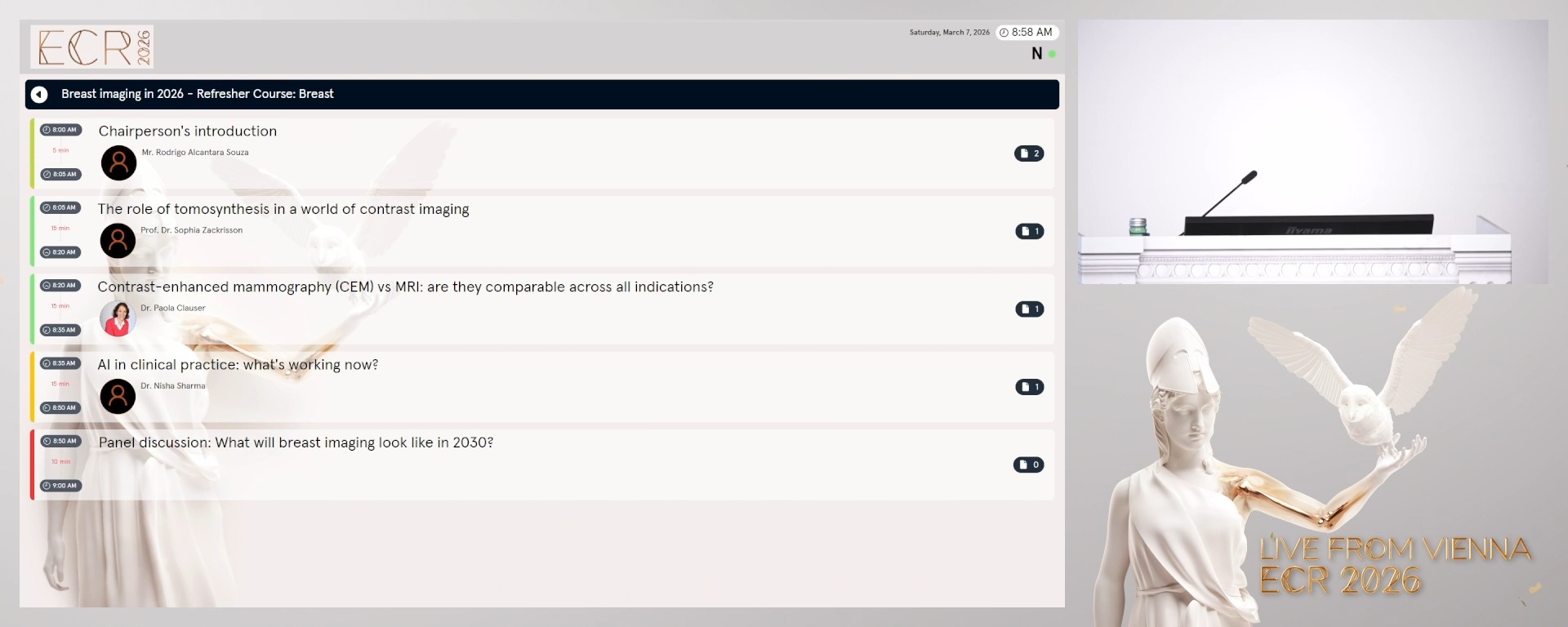
Panel discussion: What will breast imaging look like in 2030?
10:00Panel discussion: What will breast imaging look like in 2030?
5 min
Chairperson's introduction
Rodrigo Alcantara Souza, Barcelona / Spain
15 min
The role of tomosynthesis in a world of contrast imaging
Sophia Zackrisson, Malmö / Sweden
- To understand the fundamental differences between contrast-enhanced imaging and tomosynthesis by exploring how each technique works and what their individual roles in breast imaging are.
- To evaluate the complementary roles of contrast-enhanced imaging and tomosynthesis in clinical practice and how they may be combined.
- To assess future potential and technological advancements for both imaging techniques.
15 min
Contrast-enhanced mammography (CEM) vs MRI: are they comparable across all indications?
Paola Clauser, Vienna / Austria
- To identify the specific clinical indications for which CEM and MRI are used in breast imaging.
- To evaluate diagnostic accuracy in various clinical scenarios, explore each technique's advantages and limitations.
- To explore patient preferences and experiences with CEM and MRI, considering factors such as comfort, accessibility, and cost.
15 min
AI in clinical practice: what's working now?
Nisha Sharma, Leeds / United Kingdom
- To identify and describe how diagnostic AI technologies are currently being used in breast imaging, in both the screening and symptomatic settings.
- To explore the challenges and best practices for integrating AI into existing clinical systems and workflows.
- To discuss the practical considerations for breast imagers, such as training of staff, adoption barriers, and the future potential of AI in breast imaging.
10 min
Panel discussion: What will breast imaging look like in 2030?