EuroSafe Imaging Session
EU 21 - Optimising medical imaging with AI: joint American-European approach to balancing quality and radiation
Lectures
1
Chairperson's introduction
04:00Christoph Hoeschen, Magdeburg / DE
2
The concept of appropriate image quality
14:00Ehsan Samei, Durham / US, Christoph Hoeschen, Magdeburg / DE
3
Benefit/risk assessment for AI-based imaging
14:00Ehsan Samei, Durham / US, Reinhard W.R. Loose, Nuremberg / DE
4
The goals of optimisation of medical imaging with respect to ionising radiation
12:00Jacob Sosna, Jerusalem / IL
5
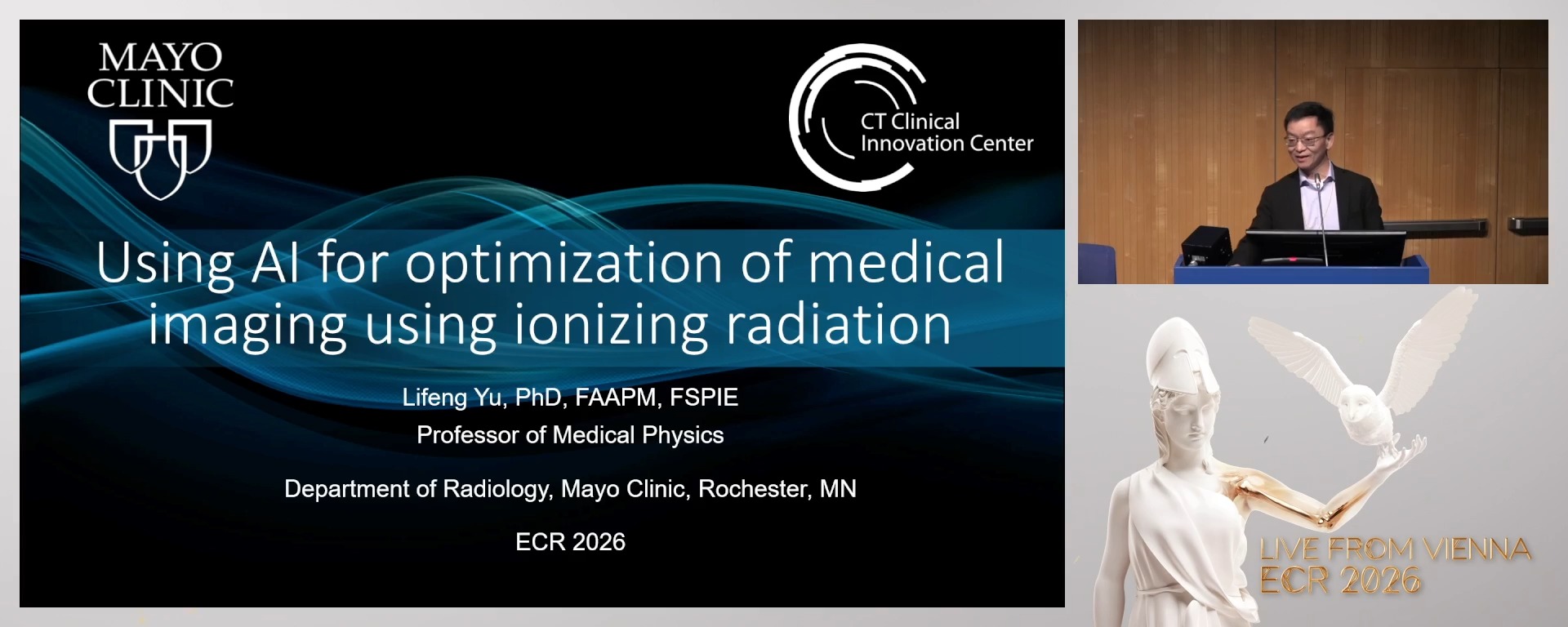
Using AI for optimisation of medical imaging using ionising radiation
12:00Lifeng Yu, Rochester / US
6
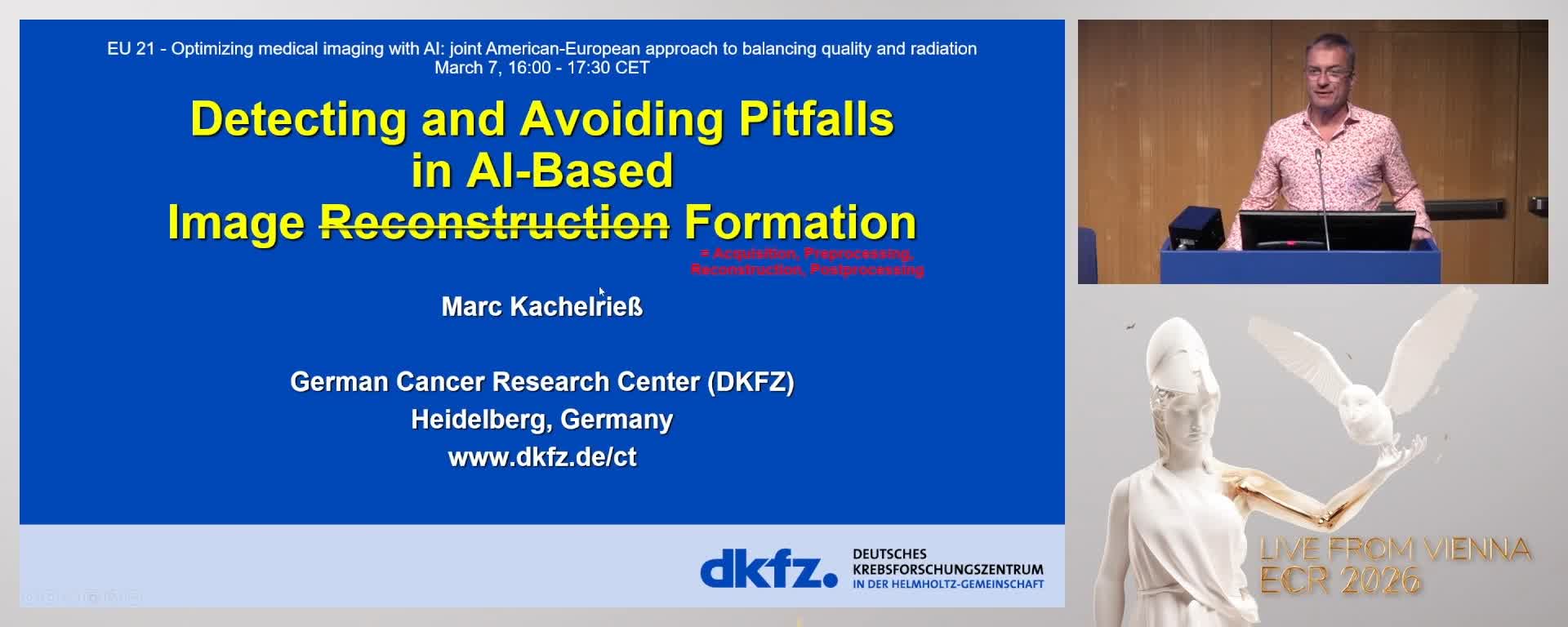
Detecting and avoiding pitfalls in AI-based image reconstruction
12:00Marc Kachelrieß, Heidelberg / DE
7
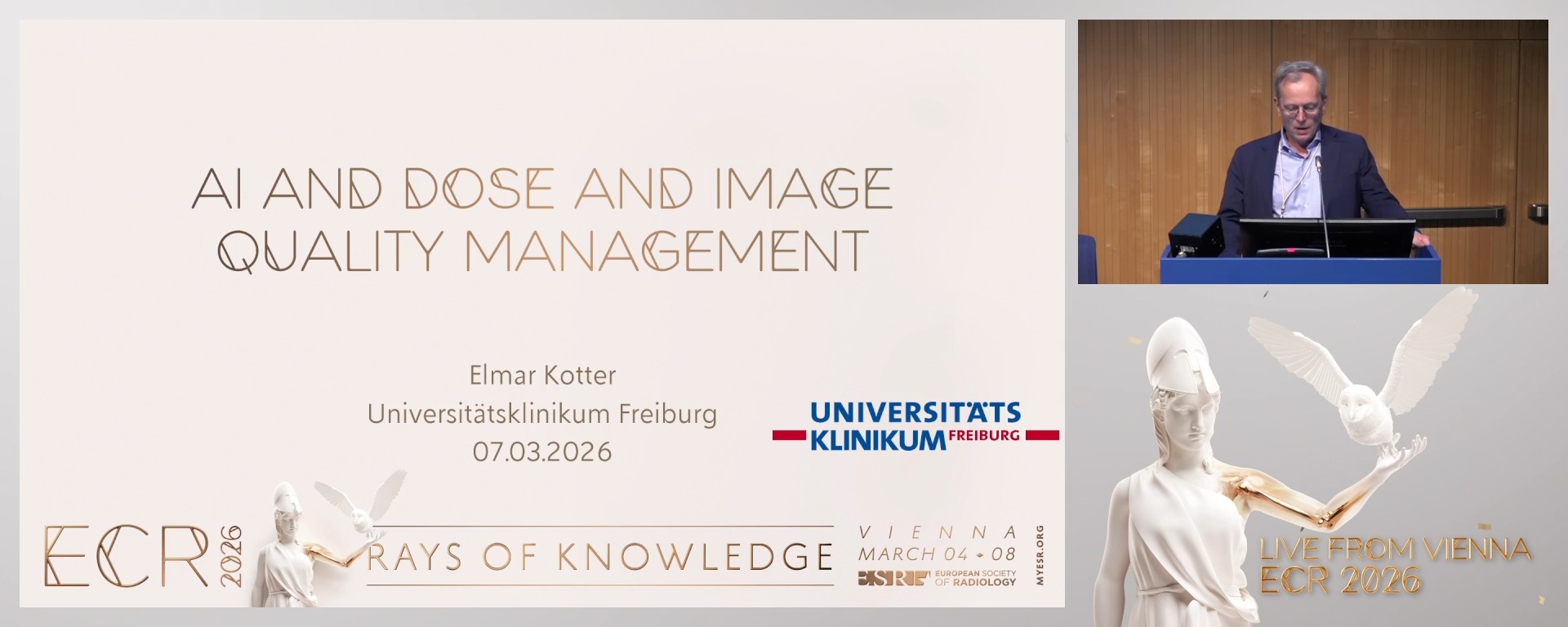
Coupling dose management and image quality management for AI-based radiological imaging
14:00Elmar Kotter, Freiburg Im Breisgau / DE, Christoph Hoeschen, Magdeburg / DE
8
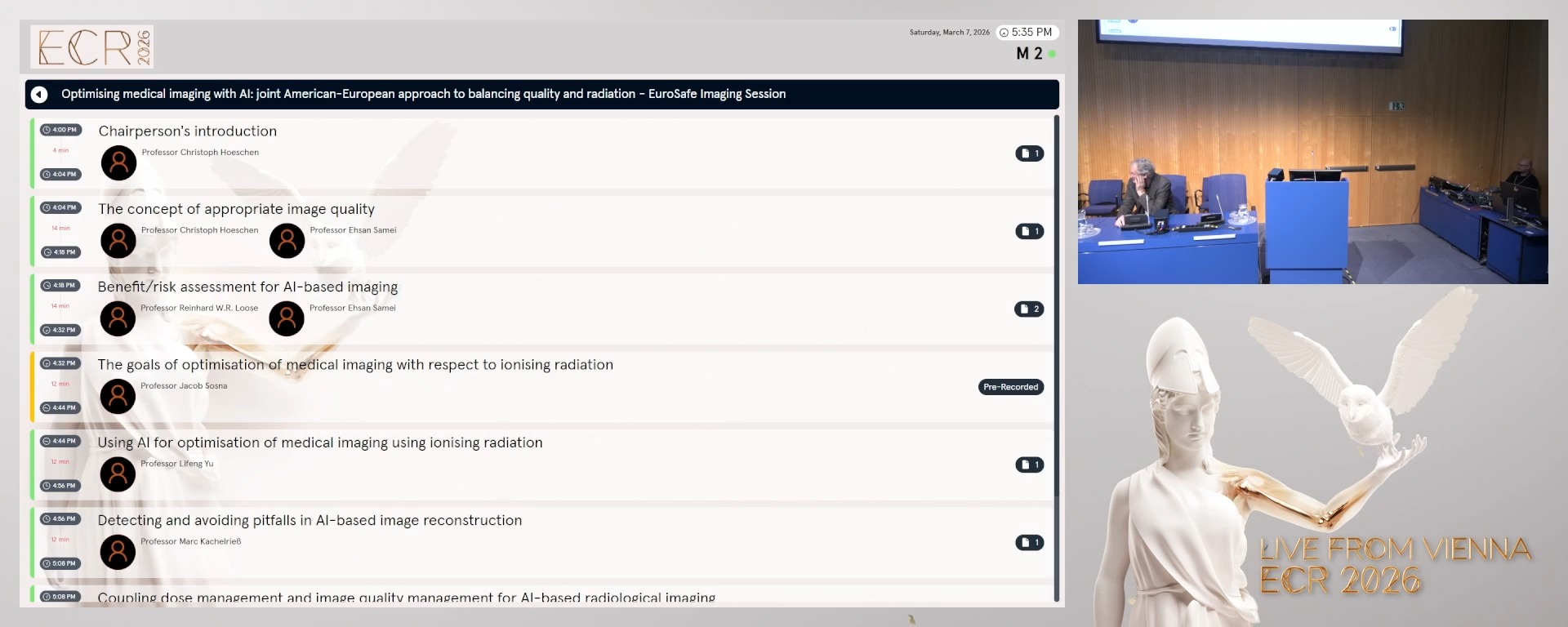
Panel discussion
08:00Panel discussion
4 min
Chairperson's introduction
Christoph Hoeschen, Magdeburg / Germany
14 min
The concept of appropriate image quality
Ehsan Samei, Durham / United States
Christoph Hoeschen, Magdeburg / Germany
Christoph Hoeschen, Magdeburg / Germany
- To learn about the concept of appropriate image quality as derived in a transatlantic common assessment of existing image quality descriptors.
- To appreciate the relation between benefits and risks in radiation-based imaging and how it is affecting appropriate image quality.
- To understand that appropriate image quality is related to the indication of a procedure, but can also describe a relevant parameter which can be tested in new approaches, such as AI-based imaging.
14 min
Benefit/risk assessment for AI-based imaging
Ehsan Samei, Durham / United States
Reinhard W.R. Loose, Nuremberg / Germany
Reinhard W.R. Loose, Nuremberg / Germany
- To appreciate the integrated role of information adequacy (image quality) and radiation allocation (dose) to effectual medical imaging, with and without AI.
- To understand how surrogates of quality and dose can be used to optimise imaging care.
- To appreciate the inherent uncertainty in the application of aggregate-based optimisation to individual-based practice.
- To place the quality-dose balance in the context of AI-informed imaging practice, including European aspects and recommendations on the use of AI in radiology.
12 min
The goals of optimisation of medical imaging with respect to ionising radiation
Jacob Sosna, Jerusalem / Israel
- To learn about the need for optimisation of medical imaging.
- To appreciate the opportunities of AI in optimising imaging studies from justification to image reconstruction.
- To understand the challenges of AI use in everyday practice.
12 min
Using AI for optimisation of medical imaging using ionising radiation
Lifeng Yu, Rochester / United States
- To learn how AI can improve image quality and/or allow dose reduction.
- To appreciate the limitations of AI in restoring signal-to-noise lost at low doses.
- To understand contrast-dependent MTF and that low-contrast smoothing can occur with AI methods.
12 min
Detecting and avoiding pitfalls in AI-based image reconstruction
Marc Kachelrieß, Heidelberg / Germany
- To see that subtle anatomical changes may be introduced by AI-based image reconstruction.
- To learn how a dedicated metric could penalise such modifications.
- To understand how hallucinations could be detected or visualised.
14 min
Coupling dose management and image quality management for AI-based radiological imaging
Elmar Kotter, Freiburg Im Breisgau / Germany
Christoph Hoeschen, Magdeburg / Germany
Christoph Hoeschen, Magdeburg / Germany
- To learn how dose and image management are related.
- To appreciate the challenges in dose and image quality management.
- To understand how AI can help in image and dose management.
8 min
Panel discussion