Refresher Course: Emergency Imaging
RC 317 - When clots hit: spectrum of disease and imaging techniques
Lectures
1
Chairperson's introduction
02:00Paulina M Cewe Jönsson, Solna / SE
2
Ischaemic stroke: latest updates on imaging
12:00Stefan Roosendaal, Amsterdam / NL
3
Pulmonary embolism and deep vein thrombosis: update on protocols and workflow
12:00Ilkay Sedakat Idilman, Ankara / TR
4
Often underdiagnosed or even ignored diseases of the abdomen and clots in the abdominal veins: how to diagnose and optimise different imaging modalities
12:00Ali Devrim Karaosmanoğlu, Ankara / TR
5
Cerebral venous and sinus thrombosis: a challenge when on call
12:00Tormund Njølstad, Bergen / NO
6
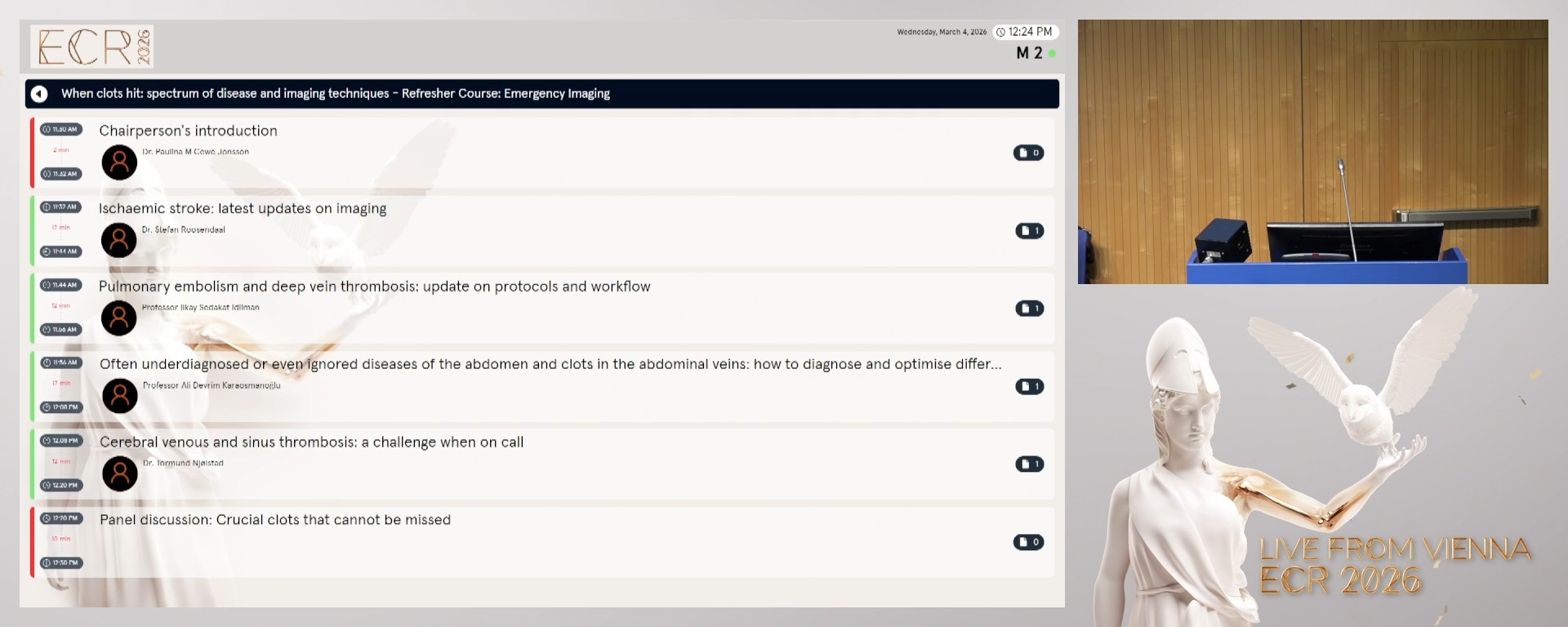
Panel discussion: Crucial clots that cannot be missed
10:00Panel discussion: Crucial clots that cannot be missed
2 min
Chairperson's introduction
Paulina M Cewe Jönsson, Solna / Sweden
12 min
Ischaemic stroke: latest updates on imaging
Stefan Roosendaal, Amsterdam / Netherlands
- To review current imaging protocols for acute ischaemic stroke.
- To interpret key imaging signs that influence eligibility for reperfusion therapies such as intravenous thrombolysis and mechanical thrombectomy.
- To understand recent advancements and guideline updates in stroke imaging, including extended time windows and the use of advanced perfusion techniques for patient selection.
12 min
Pulmonary embolism and deep vein thrombosis: update on protocols and workflow
Ilkay Sedakat Idilman, Ankara / Turkey
- To review current imaging protocols for diagnosing pulmonary embolism and deep vein thrombosis.
- To understand workflow optimisations and decision-making algorithms for rapid triage and imaging of patients with suspected thromboembolic disease.
- To recognise recent advances in diagnosing pulmonary embolism and deep vein thrombosis.
12 min
Often underdiagnosed or even ignored diseases of the abdomen and clots in the abdominal veins: how to diagnose and optimise different imaging modalities
Ali Devrim Karaosmanoğlu, Ankara / Turkey
- To identify imaging findings of abdominal venous thrombosis and distinguish bland thrombus from tumoral thrombus across different vascular segments.
- To learn how to select and optimise the appropriate imaging modality (CT, MRI, or US) based on clinical presentation and specific patient cases.
- To learn to recognise and evaluate the spectrum of clinical and radiological complications associated with abdominal venous thrombosis.
12 min
Cerebral venous and sinus thrombosis: a challenge when on call
Tormund Njølstad, Bergen / Norway
- To recognise the clinical signs and symptoms of cerebral venous sinus thrombosis (CVST) and understand the differential diagnosis when evaluating a patient on call.
- To understand the role of imaging, particularly MRI and MR venography (MRV), in diagnosing CVST, and differentiate it from other causes of intracranial pathologies.
- To evaluate the management strategies for CVST, including the indications for anticoagulation, thrombolysis, the role of endovascular intervention, and when to involve a multidisciplinary team.
10 min
Panel discussion: Crucial clots that cannot be missed